
Heritage and memory · Guide 2026
Visit Montmartre Cemetery
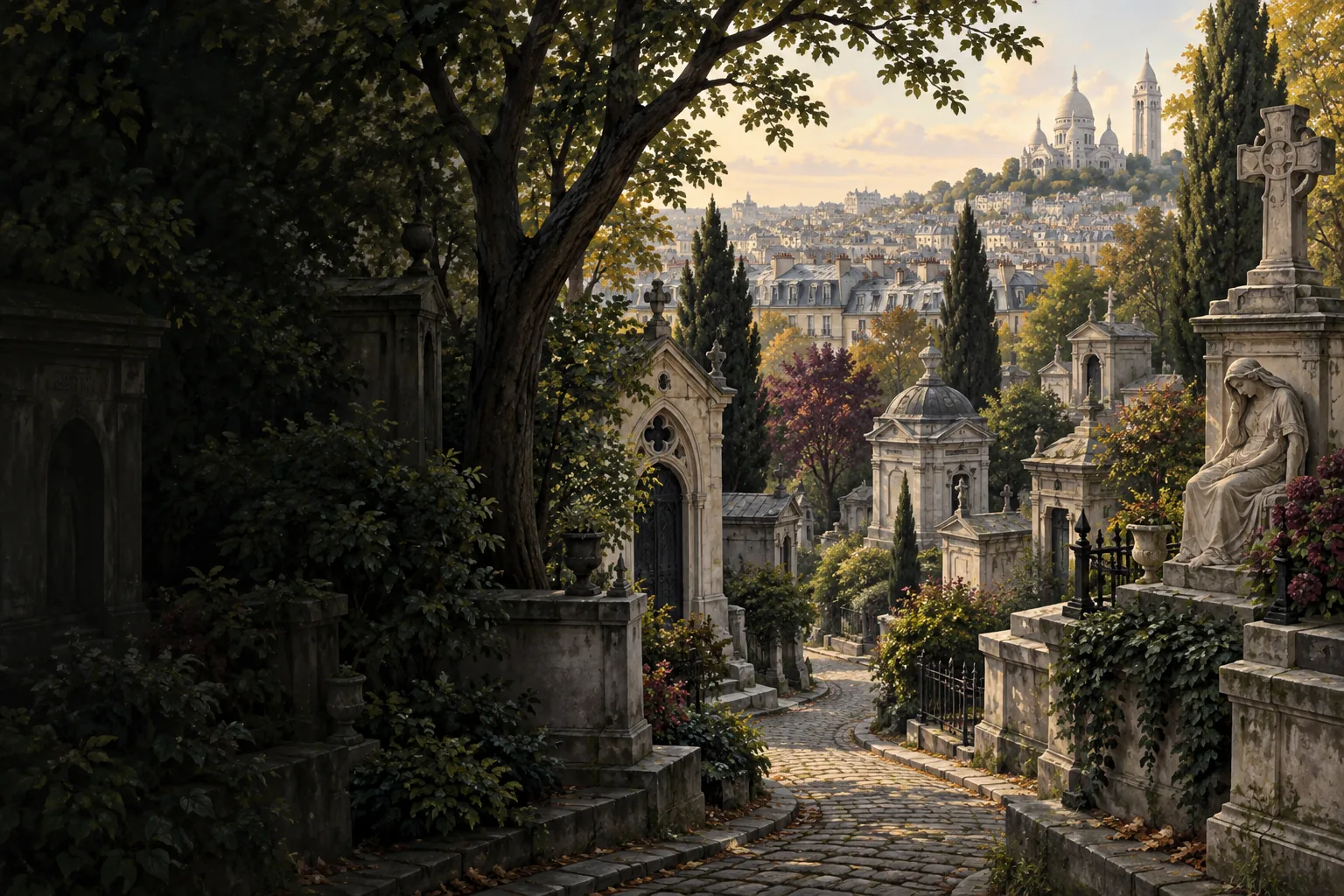
Montmartre Cemetery is more than a list of famous names. Set on former quarries, it brings together sloping paths, funerary monuments and mature trees beneath the Caulaincourt bridge. A quiet walk reveals another side of the hill, provided visitors remember that this remains a place of mourning where funerals take place every day.
The short answer
What matters before you go.
Enter from avenue Rachel, download the City map first and choose only a few sections. The City also provides an accessible route and a route devoted to notable women. Graves are not stage sets: always give priority to families, ceremonies and cemetery staff.
Action plan
The route,
step by step.
Times and order are guideposts. Always adapt the visit to crowds, actual access and your group’s energy.
Start with the map
The public entrance is at 20 avenue Rachel. Open the City map on your phone or print it beforehand: its divisions, paths and inner avenues do not work like ordinary city streets. Check the day’s closing time too; admission stops before the gates close.
Read the former quarry landscape
The Northern Cemetery replaced an earlier burial ground opened in 1798 above abandoned gypsum quarries. Ground works preceded its 1825 opening. Notice changes of level and retaining walls without leaving permitted paths: the terrain is part of its history.
Choose a theme, not a checklist
The official map marks frequently requested graves and offers a route focusing on notable women. Pick a few stops that match your interests — music, film, literature or funerary art — and leave time for paths and trees. Confirm exact locations on the City document.
Look toward the Caulaincourt bridge
The bridge has crossed the cemetery since 1888. It reminds visitors that this memorial landscape is also part of the living city above. On leaving, distinguish this cemetery from Saint-Vincent on the northern slope and the small Calvaire cemetery beside Saint-Pierre.
Useful trade-offs
What really changes the visit.
Respect the site
City rules prohibit picnics, pets, bicycles and games, among other activities. Do not touch memorials, avoid sound devices and keep clear of ceremonies.
Adapt the route
The City states that only some areas are accessible to visitors with reduced mobility. Use its adapted map and ask cemetery staff for advice if the slopes are a concern.
Use the right document
The City page brings together grave maps, themed routes and an English map. It is more reliable than an undated itinerary for finding a division or checking hours.
Practical questions
Before confirming the route.
Are Montmartre Cemetery and Saint-Vincent Cemetery the same place?+
No. Montmartre Cemetery is entered from avenue Rachel in Grandes-Carrières; Saint-Vincent is on rue Lucien-Gaulard near the vineyard. The City notes, for example, that Michou is buried at Saint-Vincent.
Can I visit with a pushchair or wheelchair?+
The site has roughly 20 metres of elevation change and some areas are difficult to access. The City publishes an adapted route; consult it before choosing stops and check current conditions.
Should I try to find every famous grave?+
No. A small selection guided by the official map leaves time for the landscape and monuments without turning the cemetery into a treasure hunt.
Check on the day
Official and practical sources.
Hours, outages, works, prices and access conditions change. For any important requirement, check the relevant source and contact the venue directly.
