
Urban reading · Guide 2026
Understand Montmartre architecture
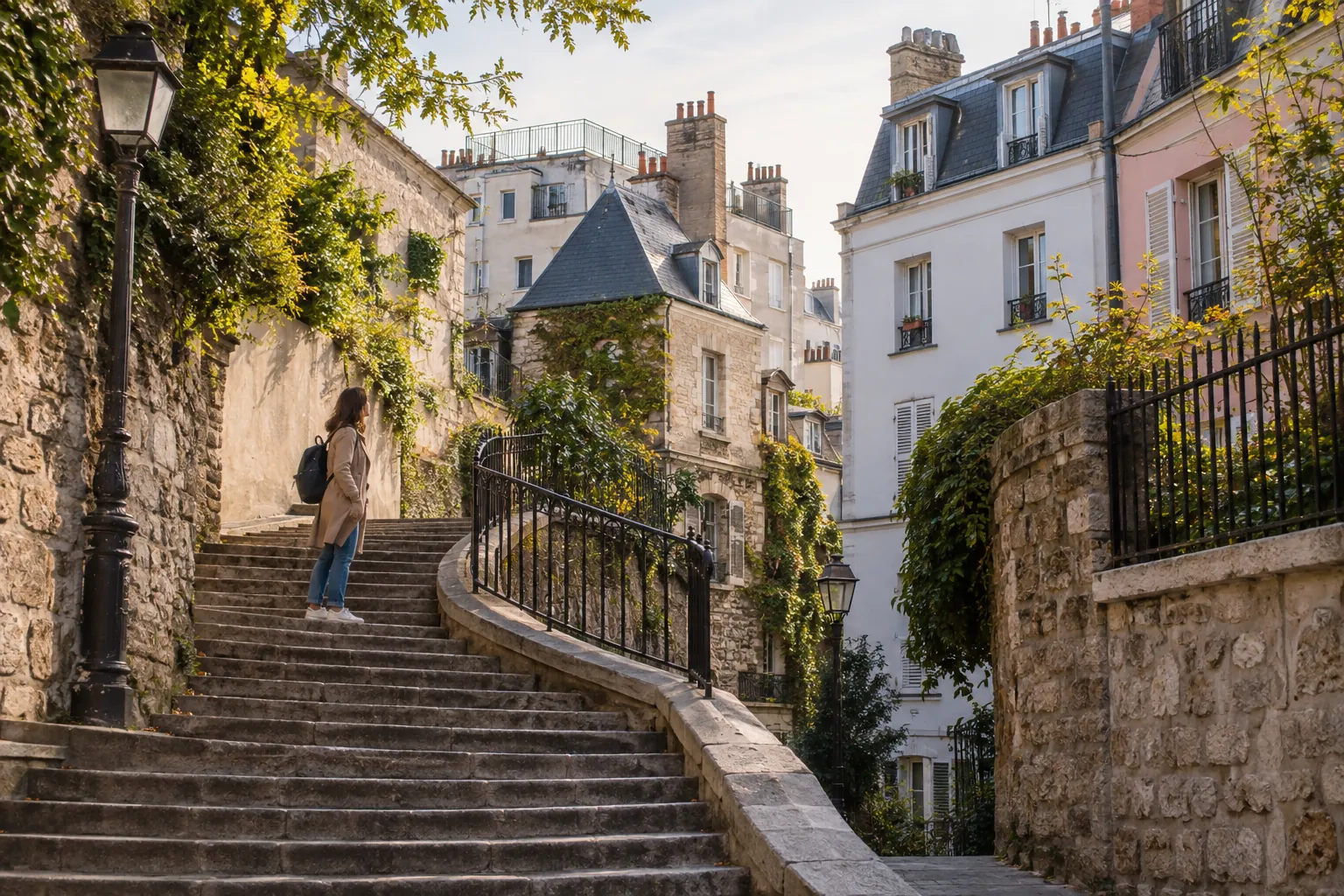
Montmartre architecture is more than a postcard backdrop: it records a former village absorbed by Paris, a slope shaped by stairways and retaining walls, religious buildings from different periods and buildings adapted to irregular plots. This route is about observing from public space without confusing historic character with public access.
The short answer
What matters before you go.
Start at Saint-Pierre de Montmartre to compare religious layers, study the small plots around place du Tertre, then follow stairways and walls towards Abbesses. Look at materials, alignments, level changes and ground floors. Stay in public space: visible courtyards, gardens and studios are not necessarily open.
Action plan
The route,
step by step.
Times and order are guideposts. Always adapt the visit to crowds, actual access and your group’s energy.
Saint-Pierre and summit layers
Observe the scale, volumes and materials of Saint-Pierre before comparing its position with Sacré-Cœur. Interior access depends on hours and religious use.
Plots around place du Tertre
Leave the main axis to study façade widths, corners and shifts in alignment. Small irregularities record the village’s gradual transformation.
Stairways and retaining walls
Stairways are not only photogenic: they manage elevation and organise movement. Compare steps, rails, walls and sloping streets.
Abbesses and modern Paris
Finish around Abbesses station and Saint-Jean church. Here the area shows the meeting of Parisian urbanisation, transport and local identity.
Useful trade-offs
What really changes the visit.
Look up
Cornices, roofs, railings and joins between buildings are easier to read away from shop windows.
Respect private space
An open door or visible courtyard is never an invitation to enter.
Compare, do not guess dates
Base precise dating on heritage records and institutional sources.
Practical questions
Before confirming the route.
Is Saint-Pierre older than Sacré-Cœur?+
Yes. Saint-Pierre de Montmartre preserves a medieval history, while Sacré-Cœur belongs to a much later period. Consult official records for the precise phases.
Can I visit courtyards and studios?+
Only when a venue explicitly announces an opening, visit or event. Otherwise, observe from the public street.
Check on the day
Official and practical sources.
Hours, outages, works, prices and access conditions change. For any important requirement, check the relevant source and contact the venue directly.

